Northrop Grumman Ships Final Artemis III Booster Segments, Igniting Humanity's Next Great Leap in Space
Proven solid rocket motors continue to drive America's return to the Moon and beyond

Northrop Grumman's twin solid rocket booster segments enroute to Kennedy Space Center. (Photo Credit: Northrop Grumman)
(JUN 3) PROMONTORY, Utah - Northrop Grumman (NYSE: NOC) shipped the final eight twin solid rocket booster motor segments for NASA's Artemis III mission to Kennedy Space Center, Florida, where they will be stacked this summer. The solid rocket boosters' proven performance is ready now to support NASA's goal of sustained lunar exploration and eventual missions to Mars.
-
Upon arrival, the booster segments will join the previously delivered segments shipped in April to be the first hardware assembled on the mobile launch platform.
-
Northrop Grumman's industry-leading solid rocket boosters generate 7.2 million pounds of thrust at lift-off, providing much of the thrust needed for NASA's Space Launch System (SLS) during the Artemis III mission, which will send astronauts and critical cargo aboard the Orion spacecraft to test rendezvous operations in low-Earth orbit with human landing systems.
-
With uniquely equipped facilities and a highly skilled workforce, the company can accelerate solid rocket motor production to meet NASA's increased Artemis mission launch cadence while supporting broader national security and space exploration objectives.
Northrop Grumman
As W88 Production Ends, Sandia Looks to Next Phase
(MAY 28) ALBUQUERQUE, N.M. - Sandia National Laboratories and the nuclear security enterprise completed production of the W88 Alteration 370 and fully transitioned the modernized warhead into the U.S. nuclear stockpile, shifting the program's focus to long-term sustainment. More
GT 256: ICBM Test Launch Verifies System Reliability

An unarmed Minuteman III Intercontinental Ballistic Missile launches during an operational test at 12:01 Pacific Time, May 20, 2026, at Vandenberg Space Force Base, Calif. ICBM test launches help ensure the U.S. ICBM fleet is ready, reliable and effective. (U.S. Air Force photo by Staff Sgt. Joshua LeRoi)
(MAY 20) BARKSDALE AIR FORCE BASE, La. -- Air Force Global Strike Command conducted a test launch of an unarmed Minuteman III intercontinental ballistic missile May 20 at 12:01 a.m. Pacific Time from Vandenberg Space Force Base, California. More
Organ Pipe Cactus National Monument Officially Designated as an International Dark Sky Park
(MAY 15) Ajo, Arizona - The National Park Service and DarkSky International are pleased to announce Organ Pipe Cactus National Monument as an International Dark Sky Park, a place recognized for its incredible night skies and passionate local community dedicated to protecting them. More
Rocket Lab and Raytheon Selected To Demonstrate Advanced Capabilities For U.S. Space Force's Space Based Interceptor Program
(MAY 7) LONG BEACH, Calif. - Rocket Lab Corporation (Nasdaq: RKLB), a leading launch and space systems company, today announced that in partnership with Raytheon it has been selected to demonstrate advanced capabilities for the United States Space Force's Space Based Interceptor program. The program is an important step in strengthening national missile defense capabilities.
"Next-generation missile defense, including the ability to counter hypersonic threats, is a national security priority – one that the joint Rocket Lab and Raytheon team stands ready to deliver on," said Brad Clevenger, President of Rocket Lab USA. "Rocket Lab is already a trusted mission partner for national security and defense programs across our launch and space systems portfolios, and we're proud to add the Space Based Interceptor program to that growing list. A threat as real and rapid as hypersonic and maneuverable missiles demands proven technology and a proven team that executes mission after mission, which is exactly what we're bringing to this program."
Together, Raytheon and Rocket Lab are contributing proven expertise to advance the development of effective solutions for this urgent security need. Raytheon and Rocket Lab stand ready to deliver.
Rocket Lab
Falcon 9 Sonic Boom Advisory
(MAY 1) SpaceX is targeting Saturday, May 2 for Falcon 9's launch of the CAS500-2 mission to low-Earth orbit from Space Launch Complex 4E (SLC-4E) at Vandenberg Space Force Base in California. The 37-minute launch window opens at 11:59 p.m. PT. If needed, there is a backup opportunity on Sunday, May 3 with the same window.
About eight minutes after liftoff, Falcon 9's first stage will land on SpaceX's Landing Zone 4 (LZ-4) at Vandenberg Space Force Base, California. There is the possibility that residents of Santa Barbara, San Luis Obispo, and Ventura counties may hear one or more sonic booms during the landing, but what residents experience will depend on weather and other conditions.
SpaceX's live webcast will begin approximately 15 minutes before Falcon 9's liftoff at spacex.com/launches.
SpaceX
NASA's Curiosity Finds Organic Molecules Never Seen Before on Mars
Seven organic molecules were identified for the first time on Mars, increasing our understanding of the kinds of molecular preservation possible on the Martian surface.
(APR 7) After years of lab work, the results are in: A rock that NASA's Curiosity Mars rover drilled and analyzed in 2020 includes the most diverse collection of organic molecules ever found on the Red Planet. More
U.S. Space Force Advances Heavy Launch Capability Development at Vandenberg
(APR 14) VANDENBERG SPACE FORCE BASE, Calif. - The U.S. Space Force (USSF) has selected Blue Origin to continue in the process for final determination of a lease in response to the Request for Information (RFI) issued Dec. 30, 2025. This selection will advance discussions with SLD 30 regarding detailed terms and conditions to obtain a real property use agreement for the development and operation of heavy or super-heavy vertical space launch capabilities at Space Launch Complex-14 (SLC-14).
"The down-selection of Blue Origin to continue in the process for final determination of a lease at SLC-14 represents a critical milestone at the Vandenberg Spaceport," said USSF Col. James Horne III, SLD 30 commander. "By taking the next steps to further develop heavy and super-heavy space launch capabilities at SLC-14, we're continuing to unleash our capacity to execute full-spectrum space operations for the nation."
The RFI was issued to identify launch service providers capable of providing large-scale launch operations at SLC-14, an undeveloped location at the southernmost point of Vandenberg Space Force Base (VSFB). This effort supports the USSF Commercial Space Strategy, enhances national security, and aligns with federal space objectives.
Respondents were evaluated based on technical capability, financial maturity and alignment with U.S. government requirements. The selection of Blue Origin reflects their ability to meet these criteria and contribute to the development of heavy or super-heavy launch capabilities at Vandenberg Space Force Base.
SLC-14 is considered the most viable site at VSFB for heavy and super-heavy launch operations due to its location.
Several crucial milestones must be achieved before any construction or launch activities can commence, to include safety assessments and an environmental impact analysis. The timeline for increased launch activity will depend on the completion of the safety and environmental analysis and subsequent infrastructure development.
Expanding launch operations at Vandenberg is expected to create jobs, drive economic growth, enhance the region's role in assured access to space and increase national security.
Vandenberg SFB
U.S.Space Force Launches DoW STP-S29A Mission, Delivers Experimental and Research Payloads
(APR 7) EL SEGUNDO, Calif. -- The U.S. Space Force's (USSF) Space Systems Command (SSC) launched the U.S. Department of War's (DoW) Space Test Program S29A (STP-S29A) mission aboard a Minotaur IV launch vehicle from Space Launch Complex 8 at Vandenberg Space Force Base, Calif., at 4:33 a.m. PDT, April 7, 2026. More
Fire and Ice

On March 18, clouds parted around Iceland, allowing the Moderate Resolution Imaging Spectroradiometer (MODIS) on NASA's Terra satellite to capture this late-winter view (click to enlarge) of the island nation. Iceland sits just south of the Arctic Circle and, as the westernmost country in Europe, it is tucked between Greenland and the rest of Europe. The MODIS instrument was built by Santa Barbara Remote Sensing (SBRS) in Goleta, Calif. Terra was launched from nearby Vandenberg AFB, Calif. in 1999. Image Credit: MODIS Land Rapid Response Team, NASA GSFC
Sunday Launch
(APR 4) The following is an announcement from Vandenberg SFB:
"The U.S. Space Force has approved the launch of a SpaceX Falcon 9 rocket carrying the Starlink 17-35 mission to low-Earth orbit, Sunday, April 5, 2026, between 4:03 p.m. - 8:03 p.m. PT from Space Launch Complex 4 East (SLC-4).
A live webcast of this mission will begin about five minutes prior to liftoff, which you can watch at https://www.spacex.com/launches/sl-17-35 and on X @SpaceX. You can also watch the webcast on the X TV app.
There is the possibility that residents of Santa Barbara, San Luis Obispo, and Ventura counties may hear one or more sonic booms during the launch, but what residents experience will depend on weather and other conditions."
If the launch occurs in daylight, the orange flame from the first stage could be visible to the unaided eye up to 100 statute miles from the launch pad and either side of the Falcon's flight path. The vehicle should also briefly produce a white vapor trail during the early portion of the first stage burn. The second stage burn will probably be invisible. If liftoff happens after sunset, the event could be visible for several minutes over a wide area.
For a better view of the launch, use tripod-mounted binoculars or a spotting scope. An astronomical telescope with a low-power eyepiece will probably provide the best view.
For countdown status and video feeds of the launch, go to:
https://spaceflightnow.com
https://www.spacex.com/launches/sl-17-35
X @SpaceX
This information is subject to change.
Brian Webb
NMSU Astronomy Student's Research on Coronal Holes Improves Space Weather Forecasting
(MAR 26) Fast solar winds originating from the sun can have direct impacts on Earth - disrupting systems like GPS, aviation, electrical grids and satellite and radio communications. More
Utah State Awarded Contract
(MAR 20) Utah State University Space Dynamics Laboratory (USU/SDL), Logan, Utah, has been awarded a $414,000,000 contract modification to a previously awarded sole-source University Affiliated Research Center (UARC) for technical and analytical support to the Missile Defense Agency (MDA). MDA must provide a highly integrated and effective Missile Defense System to defend the homeland, regional interests, allies, and deployed forces against ballistic missile threats of all ranges and in all phases of flight. MDA requires continued access to the unique and specialized knowledge, expertise, and often proprietary data resident with USU/SDL for the development of complex and highly technical systems engineering and integration products. The objective of this cost-plus-fixed-fee contract is to provide technical and analytical support for MDA related USU/SDL core competencies in accordance with the Department of Defense UARC Engagement Guide. In this modification (P00020), the ordering period is extended to 22 November 2031, and the ceiling is increased to $714,000,000 by $414,000,000. Work will be performed in Logan, Utah, and is expected to be completed by Nov. 22 2031. This contract permits other than full and open competition for this effort using 10 U.S. Code 3204(a)(3)(B) as implemented in Federal Acquisition Regulation 6.103-3(b)(2). MDA, Huntsville, Alabama, is the contracting activity (HQ0854-22-D-0001).
Department of War
GT 255: ICBM Test Launch Verifies Multiple Reentry Vehicles, System Reliability
(MAR 4) VANDENBERG SPACE FORCE BASE, Calif. (AFNS) -- Air Force Global Strike Command conducted a test launch of an unarmed Minuteman III intercontinental ballistic missile equipped with two test re-entry vehicles March 3, at 11:01 p.m. Pacific Time from Vandenberg Space Force Base. More
Erie Ice

Several weeks of frigid Arctic air transformed Lake Erie from an open water lake topped with a little ice into a vast expanse of white. On February 15, the Moderate Resolution Imaging Spectroradiometer (MODIS) on NASA's Aqua satellite acquired this true-color image of widespread cracking and melting of Lake Erie's extensive coating of winter ice. Aqua was launched from Vandenberg SFB aboard a Delta II rocket in 2002. Image credit: MODIS Land Rapid Response Team, NASA GSFC
Minuteman III Launch Scheduled
(FEB 27) VANDENBERG SPACE FORCE BASE, Calif. -- An operational test launch of an Air Force Global Strike Command unarmed Minuteman III intercontinental ballistic missile is scheduled between 11:01 p.m. to 5:01 a.m. Pacific Time, Mar. 3 to Mar. 4, from north Vandenberg.
The purpose of the ICBM test launch program is to validate and verify the effectiveness, readiness and accuracy of the weapon system, according to AFGSC.
This test is routine and was scheduled years in advance.
Vandenberg SFB
Caltech Mourns the Passing of Carl Grillmair (1959-2026)
Carl Grillmair, an astronomer at Caltech's IPAC science and data center for astronomy and planetary science, passed away suddenly on February 16, 2026. He was 67 years old.
(FEB 21) Grillmair's science interests spanned many topics, such as exoplanets and stellar streams, which are remnants from ancient collisions between our Milky Way and other galaxies. More
Twilight Trail

The twisted exhaust from a Falcon 9 rocket is illuminated by the Sun and suspended in the dusk sky following liftoff from Vandenberg SFB, Calif. on February 14. The vehicle was launched from south base during evening twilight and carried several Starlink satellites into orbit.
Rocket Lab Prepares To Launch Latest Hypersonic Test Mission for Defense Innovation Unit
(FEB 12) Long Beach, Calif.: Rocket Lab Corporation (Nasdaq: RKLB) ("Rocket Lab" or "the Company"), a global leader in launch services and space systems, today announced its next launch is a dedicated mission on its HASTE rocket for the Department of War's Defense Innovation Unit (DIU).
The mission, named Cassowary Vex, is scheduled to launch no earlier than late February from Rocket Lab Launch Complex 2 within the Virginia Spaceport Authority's Mid-Atlantic Regional Spaceport on Wallops Island, Virginia.
The HASTE launch, dubbed 'That's Not A Knife," is the latest mission of the DIU and will deploy DART AE, a scramjet-powered aircraft developed by Australian aerospace engineering firm Hypersonix.
This latest HASTE launch, the Company's fourth hypersonic test mission in under six months, reflects Rocket Lab's investment in restoring the nation's hypersonic test capabilities through its commercial speed, innovation, and execution - a critical priority for the Department of War. By lowering cost barriers and increasing the test launch tempo for the United States and its allies, HASTE gives testers unprecedented control over flight profiles and environments up to Mach 20 - a commercial capability that remains unmatched globally and expands and secures U.S. space superiority.
Rocket Lab
Mines Researcher Part of NASA-selected Satellite Mission
Satellite measuring land, polar and coastal regions could launch as soon as 2030
(FEB 5) A Colorado School of Mines professor is part of an international research team selected by NASA for a satellite mission for the Earth System Explorers (ESE) program. More
U.S. Space Force Field Commands Prepare Upcoming GPS III Launch to Enhance Warfighter Capabilities
(JAN 22) EL SEGUNDO, Calif. & COLORADO SPRINGS, Colo. -- U.S. Space Force's Space Systems Command (SSC) and Combat Forces Command (CFC) will launch the next National Security Space Launch (NSSL) GPS III mission with Space Vehicle (SV)09 aboard a SpaceX Falcon 9 rocket from Space Launch Complex (SLC)-40 at Cape Canaveral Space Force Station, Fla. This next GPS III launch is planned for Jan. 25, 2026.
The 15-minute window opens at 11:46 p.m. ET with a backup opportunity available at 11:42 p.m. PT on Monday, January 26.
The two field commands are executing this mission using the model established by the Rapid Response Trailblazer launch in December 2024 and GPS III-7 (SV08) launch in May 2025. Being pre-postured with the right equipment has enabled the launch teams to process and integrate the GPS III (SV09) satellite with the Falcon 9 rocket on a shortened timeline.
GPS III satellites, equipped with M-Code technology, provide the warfighter with a significantly more accurate and jam-resistant capability. Adding another such satellite to the constellation enhances the system's robustness and ultimately boosts the warfighting lethality of the Joint Force.
The space vehicle was successfully delivered to Florida over-the-road on July 31, 2025. Now, CFC's Mission Delta 31 is leading the pre-launch processing of the space vehicle, working alongside Lockheed Martin to integrate it onto the rocket and for launch in a faster timeline than in the past.
SV09 is named in honor of Col. Ellison Onizuka, a U.S. Air Force test pilot and NASA astronaut. Onizuka successfully flew on STS-51C, a space shuttle Discovery mission in January 1985. The naming of the satellite also honors his memory as one of the astronauts who perished during the launch of STS-51L aboard the space shuttle Challenger on Jan. 28, 1986. With the launch of SV09, the GPS III constellation gains another satellite equipped with significantly enhanced accuracy and jam-resistance, bolstering the capabilities of the Joint Force.
U.S. Space Force Space Systems Command
NASA's SpaceX Crew-11 Mission Returns, Splashes Down off California
(JAN 15) NASA's SpaceX Crew-11 mission safely splashed down early Thursday morning in the Pacific Ocean off the coast of San Diego, concluding a more than five-month mission aboard the International Space Station. More
Historic Lick Observatory Closes to Public Following Significant Wind Damage
Early on Thursday, Dec. 25, severe winds gusting up to 114 miles per hour tore loose half of the shutter on the 140-year old 36-inch Great Refractor dome. No one was injured.
(DEC 26) Lick Observatory is temporarily closed to the public, following a windstorm that caused significant damage to the University of California research facility. More
First Results

Several months after launch from Vandenberg SFB, Calif. the first results from NASA's SPHEREx spacecraft have been released. The satellite mapped the entire sky in 102 infrared colors, which are invisible to the human eye but can be used to reveal different features of the cosmos. This image (click to enlarge) features a selection of colors emitted primarily by stars (blue, green, and white), hot hydrogen gas (blue), and cosmic dust (red). Credit: NASA/JPL-Caltech
Rocket Lab Awarded $816M Prime Contract to Build Missile- Defense Satellite Constellation for U.S. Space Force
(DEC 19) Long Beach, California - Rocket Lab USA, Inc., a wholly owned subsidiary of Rocket Lab Corporation (Nasdaq: RKLB) ("Rocket Lab" or "the Company"), a leading launch and space systems company, today announced it has been awarded a landmark prime contract by the U.S. Space Development Agency (SDA) to design and manufacture 18 satellites for the Tracking Layer Tranche 3 (TRKT3) program under the Proliferated Warfighter Space Architecture (PWSA). More
NMSU, Northwestern University Astronomers Discover New Planet in Old Data
(DEC 11) Working through years' worth of data from an old observational campaign, a team of astronomers have directly imaged a new exoplanet, meaning a planet that exists outside our solar system. More
Desert Test

Researchers from NASA's Jet Propulsion Laboratory in Southern California monitor a research drone in the Dumont Dunes area of the Mojave Desert in September as part of a test campaign to develop navigation software to guide future rotorcraft on Mars. Image cresdit: NASA/JPL-Caltech
GT 254: 625 STOS Uses ALCS, Launches Unarmed ICBM
(DEC 5) BARKSDALE AIR FORCE BASE, La. -- Airmen assigned to the 625th Strategic Operations Squadron employed the Airborne Launch Control System (ALCS) aboard a U.S. Navy E-6B Mercury to launch a test of an unarmed Minuteman III intercontinental ballistic missile from Vandenberg Space Force Base, Calif., Nov. 5, 2025. More
Monday Launch
(NOV 30) The following is an advisory from Vandenberg SFB:
"Vandenberg Guardians and Airmen are scheduled to support the launch of 27 Starlink satellites to low-Earth orbit aboard a SpaceX Falcon 9 rocket Monday, December 1, from Space Launch Complex 4 East (SLC-4E).
Liftoff is scheduled between 6:10 - 10:10 p.m.
A live webcast of this mission will begin about five minutes prior to liftoff, which you can watch here and on X @SpaceX. You can also watch the webcast on the X TV app.
Following stage separation, the first stage will land on the Of Course I Still Love You droneship, which will be stationed in the Pacific Ocean.
There is the possibility that residents of Santa Barbara, San Luis Obispo, and Ventura counties may hear one or more sonic booms during the launch, but what residents experience will depend on weather and other conditions.
Areas local to Vandenberg SFB will hear the initial low rumble of take-off.
Vandenberg SFB continues to provide safe and reliable access to space in support of national security and homeland defense."
Weather permitting, the event could be visible to the unaided eye across much of the Southwest and northwestern Mexico. It is uncertain if the rocket's exhaust plume will be illuminated by the Sun because the launch window opens 1 hour 20 minutes after Vandenberg SFB sunset.
For countdown status and video feeds of the launch, go to:
https://spaceflightnow.com
https://www.spacex.com/launches/sl-15-10
X @SpaceX
This information is subject to change.
Brian Webb
NASA Cassini Study Finds Organics 'Fresh' From Ocean of Enceladus
(NOV 18) A new analysis of data from NASA's Cassini mission found evidence of previously undetected organic compounds in a plume of ice particles ejected from the ocean that lies under the frozen shell of Saturn's moon Enceladus. More
GT-254: AFGSC Validates Reliability, Readiness of ICBM Force with Minuteman III Test Launch

An unarmed Minuteman III Intercontinental Ballistic Missile launches during an operational test at 01:35 Pacific Time Nov. 5 at Vandenberg Space Force Base, Calif. ICBM systems require regular testing to verify system performance and identify any potential issues. (U.S. Space Force photo by Tech. Sgt. Draeke Layman)
(NOV 5) VANDENBERG SPACE FORCE BASE, Calif. - Air Force Global Strike Command conducted a test launch of an unarmed Minuteman III intercontinental ballistic missile from Vandenberg Space Force Base, California, on November 5, 2025. More
Naval Grant to Improve Ionospheric Research Over the Open Ocean
(OCT 27) BOULDER, Colorado - Brian Breitsch is improving our understanding of the upper atmosphere in some of the most isolated places on Earth. More
NMSU's Apache Point Observatory to Host Open House October 11
(SEP 29) Apache Point Observatory (APO) in Sunspot, NM, in partnership with New Mexico State University's Department of Astronomy, will host an open house from 10 a.m. to 2 p.m. Saturday, October 11. This event is free and open to the public.
It will include tours of APO's site and telescopes, talks from professional astronomers and interactive demonstrations. An "Ask a Scientist" booth will give participants the opportunity to ask their questions to subject matter experts.
APO is operated by NMSU for the Astrophysical Research Consortium (ARC), which owns the facility. NMSU's Department of Astronomy manages observatory staff and infrastructure for ARC's telescopes, including its own 1-meter telescope.
Participants must be over 10 years old and able to walk up three flights of stairs at 9,500 feet elevation. Registration is required for telescope tours; groups are limited to 20 people. Call 575-437-6822 or email office_admin@apo.nmsu.edu for reservations.
For more information, contact Nancy Chanover at nchanove@nmsu.edu or APO at office_admin@apo.nmsu.edu
New Mexico State University
Space Dynamics Lab Shares Open-Source Software to Detect Potentially Dangerous Meteors
(SEP 25) NORTH LOGAN, Utah - Utah State University's Space Dynamics Laboratory has released open-source software to detect potentially harmful shooting stars, called bolides - bright meteors that explode as they enter Earth's atmosphere. More
National Radio Astronomy Observatory to Outfit the VLBA with New Ultra Wideband Receivers
(SEP 16) The U.S. National Science Foundation National Radio Astronomy Observatory (NSF NRAO) has begun a major upgrade to the NSF Very Long Baseline Array (NSF VLBA) with the development and installation of state-of-the-art ultra wideband receivers capable of operating across the frequency range of 8 to 40 gigahertz (GHz). More
Caspian Colors

Brilliant colors filled the southern Caspian Sea in early September 2025. The Moderate Resolution Imaging Spectroradiometer (MODIS) on NASA's Aqua satellite captured this true-color image (click to enlarge) of swirling greens and blues on September 3. The colors were created by a mix of suspended sediment and floating phytoplankton, which are microscopic plant-like organisms. This image of one of many impressive views returned by Aqua following launch from Vandenberg SFB, Calif. in 2002. Image credit: NASA GSFC
Space Systems Command, Space Development Agency Complete Successful Launch of First Tranche 1 Satellites
(SEP 10) EL SEGUNDO, Calif. - The U.S. Space Force's Space Development Agency (SDA) today announced the successful launch of the first Proliferated Warfighter Space Architecture Tranche 1 (T1) Transport Layer space vehicles (SV) from Vandenberg Space Force Base, California. More
NASA Marsquake Data Reveals Lumpy Nature of Red Planet's Interior
Rocky material that impacted Mars lies scattered in giant lumps throughout the planet's mantle, offering clues about Mars' interior and its ancient past.
(AUG 28) What appear to be fragments from the aftermath of massive impacts on Mars that occurred 4.5 billion years ago have been detected deep below the planet's surface. More
New NASA-ESA Sea Level Satellite Arrives at California Launch Site
The Sentinel-6B satellite will soon start final preparation to ready it for launch later this year.
(AUG 20) After a trans-Atlantic journey on a cargo ship and a truck ride from Texas to California, the international sea level satellite Sentinel-6B arrived at a NASA facility at Vandenberg Space Force Base in California Aug.18. More
Tsunami

The SWOT satellite caught the leading edge of the tsunami wave (red) that rolled through the Pacific Ocean on July 30 (click to enlarge). Sea level data, shown in the highlighted swath, is plotted against a NOAA tsunami forecast model in the background. A red star marks the location of the earthquake that spawned the tsunami. SWOT lifted off from Vandenberg Space Force Base in California aboard a SpaceX Falcon 9 rocket in 2022. Image Credit: NASA/JPL-Caltech
NASA's SpaceX Crew-10 Mission Returns, Splashes Down Off California
(AUG 9) The first crew to splash down in the Pacific Ocean off the coast of California as part of NASA's Commercial Crew Program completed the agency's 10th commercial crew rotation mission to the International Space Station on Saturday. More
Milestone Sensor Upgrade Enhances U.S. Space Force Identifying, Tracking Capability
(JUL 31) PETERSON SPACE FORCE BASE, Colo. -- U.S. Space Force (USSF) Space Operations Command (SpOC), in partnership with USSF Space Systems Command (SSC), approved the operational acceptance of a milestone upgrade to the Ground-Based Optical Sensor System (GBOSS) at the Ground-based Electro-Optical Deep Space Surveillance site in White Sands Missile Range, New Mexico. More
NASA Launches Mission to Study Earth's Magnetic Shield
(JUL 23) NASA's newest mission, TRACERS, soon will begin studying how Earth's magnetic shield protects our planet from the effects of space weather. More
Twilight Effect

A dusk rocket from California creates a light show (click to enlarge) for the Southwest and northwestern Mexico on July 18. The Falcon 9 lifted off from Vandenberg SFB at 19:52 PDT and carried several Starlink satellites into orbit. As it climbed, exhaust from the vehicle was lit up at high altitude by the Sun's rays. In the enlarged image, the white dot behind and below the front of the plume is the jettisoned first stage. The two white dots closer to the tip of the plume are the halves of the jettisoned payload shroud.
Boeing Secures $2.8B Contract to Enhance U.S. Strategic SATCOM Capabilities
(JUL 3) EL SEGUNDO, Calif., - Boeing [NYSE: BA] has been awarded a $2.8B contract for the Evolved Strategic Satellite Communications (ESS) program, the space-based component of the U.S. nuclear command, control, and communications (NC3) architecture. The initial contract is for two satellites, with options for two more in the future.
The ESS space vehicles will provide increased capacity, flexibility, reliability and resilience compared to the strategic communications satellites currently on orbit. Since 2020, Boeing has been executing technical maturation and risk reduction under a rapid prototyping contract for the U.S. Space Force.
Boeing's ESS solution is underpinned by technology the company has developed for the Wideband Global SATCOM (WGS)-11 and WGS-12 satellites and has already proven on-orbit aboard the commercial O3b mPOWER constellation. Building on these developments, this strategic military communications satellite constellation will be equipped with flexible and resilient signals to protect against interruption or interception.
When deployed in geostationary orbit - about 22,000 miles or 35,700 km from the Earth's surface - ESS will provide persistent coverage to strategic warfighters worldwide. The spacecraft will leverage a highly protected waveform and classified technologies developed in partnership with the U.S. Department of Defense.
Boeing is set to deliver the first of two space vehicles by 2031.
Boeing
Space Development Agency Completes Successful Launch of T1DES Prototype Satellite
SDA delivers first of 12 risk reduction satellites on orbit for experimentation and demonstration
(JUN 24) WASHINGTON, D.C.- The Space Development Agency today announced the successful launch from Vandenberg Space Force Base, California, of the first prototype among 12 risk reduction satellites comprising the Tranche 1 Demonstration and Experimentation System (T1DES) constellation that will demonstrate tactical data delivery to warfighter platforms to support capabilities like targeting, and missile warning and tracking of advanced missile threats.
The prototype satellite will support integration with tactical satellite communication (TACSATCOM) system capabilities from low Earth orbit. The launch also serves as a pathfinder for York Space Systems' LX-CLASS satellite platform, which is slated for use in other existing award agreements between SDA and York.
"T1DES will demonstrate mission payloads and configurations for potential proliferation through future tranches of the Proliferated Warfighter Space Architecture in an effort to lower latency of tactical data delivery and enhance beyond line-of-sight targeting capability," said SDA Director Derek Tournear. "We're very pleased to see this prototype space vehicle launch four months ahead of the original T1DES baseline schedule and before the first launch of Tranche 1's operational space vehicles."
The launch, which took place Monday, June 23, on SpaceX's Falcon 9 rocket under the Transporter 14 rideshare mission, carried to orbit SDA's single risk reduction space vehicle referred to as T1DES Proto or by the York Space Systems' name, Dragoon.
The remaining 11 T1DES satellite vehicles, planned for launch in fiscal year 2026, will conduct demonstrations and experimentation of TACSATCOM, advanced waveforms, and Integrated Broadcast Service (IBS) capabilities, which are key for future connectivity of joint warfighters around the globe.
Space Development Agency
Dusk Display

A Falcon 9 rocket creates a light show over a wide area following liftoff from Vandenberg SFB, Calif. on the evening of June 16. In this image taken during the second stage burn, the vehicle's exhaust is illuminated by the Sun at high altitude while observers on the ground are in evening twilight. The white dot behind and below the tip of the exhaust plume is the jettisoned rocket first stage.
Millennium Space Systems Delivers Pair of Space Vehicles to Launch Site for NASA's TRACERS Mission
(JUN 16) EL SEGUNDO, Calif. -- Millennium Space Systems, a Boeing Company, delivered two space vehicles for NASA's Tandem Reconnection and Cusp Electrodynamics Reconnaissance Satellites (TRACERS) mission to Vandenberg Space Force Base Friday, marking a key milestone in preparation for launch later this year.
"Millennium is incredibly proud of our team and partners at the University of Iowa, Southwest Research Institute, and NASA, for reaching this milestone and getting TRACERS to the launch site," said Richard Prasad, TRACERS program manager, Millennium Space Systems. "Progressing to final integration at launch site showcases the confidence from all parties that both the TRACERS space vehicles and the Millennium Mission Operations Center (MOC) are ready for launch and the start of operations. We're all excited to see TRACERS on-orbit."
The TRACERS mission will measure the connection between solar wind and the magnetic field surrounding Earth. With the completion of rigorous tests, including environmental, mechanical and systems verification, the space vehicles are now prepared to travel through Earth's polar cusp region over the north and south magnetic poles. Ultimately, the mission will enhance our understanding of space weather and its potential impacts on critical technologies such as satellites, communications networks and power grids.
"Delivering TRACERS demonstrates how the same approach we use for national security missions can support cutting-edge science," said Tony Gingiss, CEO, Millennium Space Systems. "The ability to deliver high-performance spacecraft is critical, not just for advancing scientific understanding and enabling future space weather forecasting, but also, for strengthening space resilience and readiness in support of national defense objectives."
The launch window is set to open in Summer 2025, with specific timing dependent on mission readiness and other logistics.
Millennium Space Systems
Stratolaunch Awarded Contract
(JUN 13) Stratolaunch LLC, Mojave, California, has been awarded a $9,900,000 firm-fixed-price and cost-plus-fixed-fee modification (P00003) to previously awarded (FA9300-23-C-6019) for changes to the flight specifications, requirements and deliverables being produced under the basic contract for the Talon-A campaign 2 contract. The modification brings the total cumulative face value of the contract to $28,063,854. Work will be performed at Mojave, California, and is expected to be completed by Sept. 16, 2026. Fiscal 2024 research, development, test, and evaluation funds in the amount of $9,900,000 are being obligated at the time of award. The Air Force Test Center, Edwards Air Force Base, California, is the contracting activity.
Department of Defense
RTS Professionals Support Air Force Glory Trip
(JUN 5) REDSTONE ARSENAL, Ala. - A U.S. Army Space and Missile Defense Command team played an important behind-the-scenes role in supporting the Air Force's Glory Trip-253. More
Fiery Return

A Dragon cargo ship streaks across the sky on the evening of May 24 as it reenters the atmosphere moments before splashing down in the Pacific west of Oceanside, Calif. Rick Baldridge recorded the scene from Lick Observatory above San Jose, Calif. Image copyright 2025, Rick Baldridge. Used with permission.
Minuteman III Test Launch Showcases Readiness of U.S. Nuclear Force's Safe, Effective Deterrent
(MAY 21) BARKSDALE AIR FORCE BASE, La. -- A joint team of Air Force Global Strike Command Airmen launched an unarmed Minuteman III intercontinental ballistic missile equipped with a single Mark-21 High Fidelity Re-Entry Vehicle May 21 at 12:01 a.m. Pacific Time from Vandenberg Space Force Base, California. More
Unarmed Minuteman III Test Launch to Showcase Readiness OF U.S. Nuclear Force's Safe, Effective Deterrent
(MAY 16) Vandenberg Space Force Base, Calif. -- An operational test launch of an Air Force Global Strike Command unarmed Minuteman III intercontinental ballistic missile is scheduled between 12:01 to 5:01 a.m. Pacific Time, May 21, from north Vandenberg.
The purpose of the ICBM test launch program is to demonstrate the readiness of U.S. nuclear forces and provide confidence in the lethality and effectiveness of the nation's nuclear deterrent, according to Air Force Global Strike Command.
This test is routine and was scheduled years in advance. Consistent with previous test launches, this ICBM test launch will validate and verify the effectiveness, readiness and accuracy of the weapon system.
Vandenberg SFB
Department of Defense Demonstrates Reusability of Hypersonic Test Vehicle
(MAY 5) The U.S. Department of Defense Test Resource Management Center (TRMC), in partnership with Naval Surface Warfare Center Crane Division (NSWC Crane), conducted a second successful flight of a fully recoverable uncrewed hypersonic test vehicle in March 2025, within three months of the first test in December 2024. This test campaign marks the Nation's first return to reusable hypersonic flight testing since the manned X-15 program ended in 1968.
In both tests, the Stratolaunch Talon-A hypersonic vehicle launched from the Roc carrier aircraft, flew over the Pacific Ocean and achieved speeds greater than Mach 5 before landing at Vandenberg Space Force Base. The landmark tests supported the ongoing TRMC Multi-Service Advanced Capability Hypersonics Test Bed (MACH-TB) project.
George Rumford, Director of the TRMC, stated, "Demonstrating the reuse of fully recoverable hypersonic test vehicles is an important milestone for MACH-TB. Lessons learned from this test campaign will help us reduce vehicle turnaround time from months down to weeks."
MACH-TB accelerates delivery of advanced hypersonic capabilities to the warfighter by providing DoD, other Federal agencies, industry, and academia the capability to affordably and rapidly conduct hypersonic experiments and test hypersonic system components.
NSWC Crane awarded the MACH-TB contract to Leidos through the Strategic and Spectrum Missions Advanced Resilient Trusted Systems (S2MARTS) Other Transaction Authority (OTA) vehicle on behalf of the TRMC. As the prime contractor for MACH-TB, Leidos awarded Stratolaunch, LLC a competitive contract to provide flight test services for the program.
About TRMC
The U.S. Department of Defense Test Resource Management Center (TRMC) is a DoD Field Activity that reports directly to the Under Secretary of Defense for Research and Engineering within the Office of the Secretary of Defense. The mission of the TRMC is to ensure the readiness of DoD to experiment and test.
Defense Department
NASA's SPHEREx Space Telescope Begins Capturing Entire Sky
After weeks of preparation, the space observatory has begun its science mission, taking about 3,600 unique images per day to create a map of the cosmos like no other.
(MAY 1) Launched on March 11, NASA's SPHEREx space observatory has spent the last six weeks undergoing checkouts, calibrations, and other activities to ensure it is working as it should. More
Dawn Launch

A Falcon 9 rocket crosses the southern California sky following liftoff from Vandenberg SFB, Calif. on April 20. The vehicle left south base at 05:29 PDT and carried the NROL-145 mission into orbit. This photo was taken during the second stage burn when sunlight was illuminating the vehicle's exhaust.
NRO and Space Force Partner Through the Rocket Systems Launch Program to Launch NROL-174
NRO and Space Force partner through the Rocket Systems Launch Program to launch NROL-174
(APR 16) CHANTILLY, Va. - The National Reconnaissance Office (NRO), in partnership with U.S. Space Force Space Systems Command's (SSC) Small Launch and Targets Division, Space Launch Delta 30, and Northrop Grumman, successfully launched multiple national security payloads with the NROL-174 mission aboard a Northrop Grumman Minotaur IV rocket from Space Launch Complex 8 (SLC-8) at Vandenberg Space Force Base (VSFB) April 16, 2025, at 3:33 p.m. EDT. More
NRO Launches Ninth Proliferated Architecture Mission with NROL-192
(APR 12) CHANTILLY, Va. - The National Reconnaissance Office (NRO), in partnership with U.S. Space Force Space Launch Delta 30 and SpaceX, successfully launched the NROL-192 mission aboard a SpaceX Falcon 9 rocket from Space Launch Complex-4 East at Vandenberg Space Force Base in California on April 12, 2025, at 8:25 a.m. EDT.
Today's mission is the ninth overall launch of the NRO's architecture and third proliferated launch of 2025. The rapid deployment of NRO's proliferated constellation directly supports the needs of the people NRO serves - intelligence analysts, warfighters, policymakers, and first responders. Having hundreds of NRO satellites on orbit will allow for critical data to be delivered to NRO's stakeholders faster than ever before.
Over the past two years, NRO has launched more than 150 satellites, creating the largest and most capable government constellation on orbit in our nation's history. Continuing with this momentum, 2025 is set to be another dynamic year, with approximately one dozen NRO launches scheduled. Approximately half of these launches will focus on advancing the NRO's proliferated architecture with additional proliferated launches planned through 2029, ensuring sustained growth and innovation.
For more than 60 years, the NRO has successfully met the needs of its U.S. intelligence, military, civil, and allied partners. It remains the world's leader in unique intelligence, surveillance, and reconnaissance systems. The NRO's next-generation systems will help ensure that the right data is delivered to the right user at the right time, faster than ever before.
Additional information on upcoming launches will be available at NRO.gov/launch.
National Reconnaissance Office
ULA Wins Space Force Contract
Award represents 40 percent of the country's critical satellite launches delivered to the most challenging and exotic orbits
(APR 4) Centennial, Colo. - The U.S. Space Force announced today that United Launch Alliance (ULA) was awarded a firm, fixed-price, indefinite-delivery requirements (IDR) contact to launch 40 percent of the missions to the country's most challenging and exotic orbits on its newest launch procurement contract. This contract resulted from a competitive award under the Space Force's National Security Space Launch (NSSL) Phase 3 procurement.
"We are proud that we have launched 100 national security space missions and honored to continue serving the nation with our new Vulcan rocket," said Tory Bruno, ULA's president and CEO. "We are very pleased to be awarded 40 percent of the Phase 3 procurement. Vulcan is the right choice for critical national security space missions and is the only rocket today designed to meet all the requirements of our nation's space launch needs."
The competitive process ensures the U.S. has continued assured access to space and supports a robust domestic national security industrial base. The award represents missions ordered in fiscal years 2025 through 2029 with launches occurring through 2034. The missions will launch from Cape Canaveral Space Force Station in Florida, and from Vandenberg Space Force Base in California.
"This award constitutes the most complex missions required for national security space," said Bruno. "Vulcan continues to use the world's highest energy upper stage; the Centaur V. Centaur V's unmatched flexibility and extreme endurance enables the most complex orbital insertions continuing to advance our nation's capabilities in space."
United Launch Alliance
Operations Room
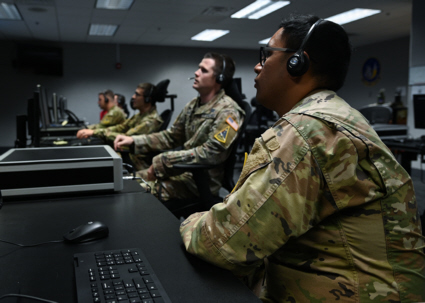
2d Space Launch Squadron members simulate usage of the newly innovated Vehicle Operations Room (VOR) at Vandenberg Space Force Base, Calif., March 5, 2025. The VOR is a newly remodeled facility designed to support the evolving needs of a diverse range of spaceport users, and signifies a significant leap forward in the base's ability to facilitate complex space missions. (U.S. Space Force photo by Senior Airman Kadielle Shaw)
ULA's Vulcan Rocket Certified to Launch National Security Missions
World's only high energy architecture rocket delivers to the country's most exotic orbits
(MAR 26) Centennial, Colo. - Following years of development and completing a comprehensive certification plan including two successful certification missions, the United Launch Alliance (ULA) Vulcan rocket has been certified by the United States Space Force to fly National Security Space Launch (NSSL) missions. More
NRO Launches Eighth Proliferated Architecture Mission with NROL-57
(MAR 21) CHANTILLY, Va. - The National Reconnaissance Office (NRO), in partnership with U.S. Space Force Space Launch Delta 30 and SpaceX, successfully launched the NROL-57 mission aboard a SpaceX Falcon 9 rocket from Space Launch Complex-4 East at Vandenberg Space Force Base in California on March 21, 2025, at 2:49 a.m. EDT.
Today's mission is the eighth overall launch of the NRO's proliferated architecture and second proliferated launch of 2025. The steady deployment of this program is quickly growing the U.S. government's largest and most resilient intelligence, surveillance, and reconnaissance constellation. This latest proliferated NRO mission continues to increase our space-based intelligence capabilities to address strategic national security needs.
Over the past two years, NRO has launched more than 150 satellites, creating the largest and most capable government constellation on orbit in our nation's history. Continuing with this momentum, 2025 is set to be another dynamic year, with approximately one dozen NRO launches scheduled. Approximately half of these launches will focus on advancing the NRO's proliferated architecture with additional proliferated launches planned through 2029, ensuring sustained growth and innovation.
For more than 60 years, the NRO has successfully met the needs of its U.S. intelligence, military, civil, and allied partners. It remains the world's leader in unique intelligence, surveillance, and reconnaissance systems. The NRO's next-generation systems will help ensure that the right data is delivered to the right user at the right time, faster than ever before.
Additional information on upcoming launches will be available at NRO.gov/launch.
National Reconnaissance Office
X-37B Orbital Test Vehicle Concludes Seventh Successful Mission
(MAR 7) VANDENBERG SPACE FORCE BASE, Calif. (AFNS) -- The X-37B Orbital Test Vehicle-7 (OTV-7), the U.S. Space Force's dynamic unmanned spaceplane, successfully deorbited and landed at Vandenberg Space Force Base, California, March 7, 2025 at 02:22 a.m. EST. More
NASA's EZIE Launching to Study Magnetic Fingerprints of Earth's Aurora
All three spacecraft carry an instrument called the Microwave Electrojet Magnetogram, built by NASA JPL, that will map electrojets to help uncover their structure and evolution.
(FEB 25) High above Earth's poles, intense electrical currents called electrojets flow through the upper atmosphere when auroras glow in the sky. More
Minuteman III Launched
(FEB 19) VANDENBERG SPACE FORCE BASE, Calif. -- A joint team of Air Force Global Strike Command Airmen and Vandenberg Space Force Base Guardians launched an unarmed Minuteman III intercontinental ballistic missile equipped with a single telemetered joint test assembly re-entry vehicle Feb. 19 at 1:00 a.m. Pacific Time from Vandenberg Space Force Base. More
Unarmed Minuteman III Test Launch to Showcase Readiness of U.S. Nuclear Force's Safe, Effective Deterrent
(FEB 12) Vandenberg Space Force Base, Calif. -- An operational test launch of an Air Force Global Strike Command unarmed Minuteman III intercontinental ballistic missile is scheduled between 11:01 p.m. Pacific Time on Feb. 18 to 5:01 a.m. Pacific Time, Feb. 19, from north Vandenberg.
The purpose of the ICBM test launch program is to demonstrate the readiness of U.S. nuclear forces and provide confidence in the lethality and effectiveness of the nation's nuclear deterrent, according to Air Force Global Strike Command.
This test is routine and was scheduled years in advance. Consistent with previous test launches, this ICBM test launch will validate and verify the effectiveness, readiness and accuracy of the weapon system.
In accordance with standard procedures, the United States will transmit a pre-launch notification pursuant to the Hague Code of Conduct, and notified the Russian government in advance, per our existing bi-lateral obligations.
Vandenberg SFB
Winter Sky

The winter sky (click to enlarge) arcs over the WIYN 3.5-meter Telescope at Kitt Peak National Observatory (KPNO) in Arizona. Visible in the upper left is the constellation Orion. The concentration of stars in the right is the Pleaides star cluster. Image Credit KPNO/NOIRLab/NSF/AURA/T. Matsopoulos
Sidus Space Announces LizzieSat™ Has Arrived at Vandenberg Space Force Base in California for Launch
Milestone positions LizzieSat™-3 for operational deployment in early 2025, bringing AI- powered advanced data services to critical industries
CAPE CANAVERAL, Fla.-- Sidus Space (NASDAQ: SIDU) (the "Company" or "Sidus"), an innovative, agile space mission enabler, today announced that LizzieSat™-3 has arrived at Vandenberg Space Force Base in California to begin spacecraft integration in preparation for its scheduled launch and deployment into low Earth orbit no earlier than the first quarter of 2025 as part of the Transporter-13 rideshare mission with SpaceX.
"With LizzieSat™-3 ready for launch, we are taking another significant step in expanding our on-orbit capabilities and delivering critical, near real-time data solutions to our customers," said Carol Craig, founder and CEO of Sidus Space. "This milestone demonstrates our commitment to providing scalable, cost-effective solutions tailored to diverse mission needs while showcasing the adaptability of our modular satellite platform."
Equipped with an advanced payload suite, LizzieSat™-3 features an AIS sensor, a high-resolution visual spectrum sensor and the HEO Holmes Imager, which powers HEO Inspect for non-Earth imaging and space object characterization. The satellite also features the next generation of Sidus' proprietary artificial intelligence system, enabling on-orbit data processing that combines multiple sources of data to provide timely, actionable insights for applications such as environmental monitoring, border security and disaster response. Through use of its space-to-space data relay module, Sidus expects to be able to provide rapid direct-to-user data transfer capability and significantly reduce data latency.
Following the successful launch of LizzieSat™-2 on December 21, 2024, which is currently in its commissioning phase, LizzieSat™-3 represents the next step in Sidus Space's commitment to delivering rapid response, flexible and cost-effective solutions tailored to the unique needs of government, defense, intelligence and commercial customers.
Sidus Space
Berkeley Lab Helps Explore Mysteries of Asteroid Bennu
The Advanced Light Source and Molecular Foundry provided powerful tools to study asteroid samples returned by NASA's OSIRIS-REx mission. Researchers found a telltale set of salts formed by evaporation that illuminate Bennu's watery past.
(JAN 29) During the past year, there's been an unusual set of samples at the Department of Energy's Lawrence Berkeley National Laboratory (Berkeley Lab): material gathered from the 4.5-billion-year-old asteroid Bennu when it was roughly 200 million miles from Earth. More
Falcon 9 Launch Delights Skywatchers

A Falcon 9 rocket creates an impressive display as it climbs into orbit at dawn on Friday. Sue Wessler recorded the event from Claremont, Calif. Image copyright 2025, Sue Wessler. Used with permission
(JAN 26) A dawn rocket from California on Friday created a light show for skywatchers over a wide area.
The SpaceX Falcon 9 rocket lifted off from Space Launch Complex 4-East (SLC-4E) at south Vandenberg Space Force Base at 06:07 PST. After rising vertically for several seconds, the vehicle turned towards the south-southeast and roughly paralleled the coast as it carried 23 Starlink satellites into orbit
During the second stage burn, at approximately T+3 minutes 30 seconds, the rocket climbed high enough for sunlight to begin illumiating the exhaust plume, resulting in an impressive display. The jettisoned first stage and payload shroud halves appeared as orange dots as they fell away from the rocket. Later, a tenuous trail from the first stage was visible as it descended for landing on a drone ship down range.
Friday's event was among the five or six most impressive Vandenberg launches I have seen since I began watching them in November of 1967.
Brian Webb
NASA's SPHEREx Telescope Arrives for Final Launch Preparations
(JAN 16) NASA's SPHEREx spacecraft arrived Tuesday, Jan. 14, at Astrotech Space Operations located inside Vandenberg Space Force Base in California for final processing before launching on its two-year mission.
The SPHEREx (Spectro-Photometer for the History of the Universe, Epoch of Reionization and Ices Explorer) observatory is targeted to launch at the end of February on a SpaceX Falcon 9 rocket from Space Launch Complex 4E.
Following launch, SPHEREx will support NASA's goals of discovering the secrets of the universe and searching for the ingredients for life elsewhere. The telescope will scan the sky in the infrared spectrum from a position in Earth orbit and complete four all-sky maps. These will allow scientists to learn about a variety of topics, including the origins of water on planets like Earth, to the physics that governed the universe less than one second after its birth.
After final tests and checkouts, teams will mate SPHEREx and its rideshare PUNCH (Polarimeter to Unify the Corona and Heliosphere) in preparation for encapsulation in the payload fairings of the Falcon 9 rocket.
NASA
SATCOM Prototype

Northrop Grumman Corporation successfully completed assembly and testing of its Protected Tactical Satcom Rapid Prototype (PTS-P) payload and delivered it to the company's facility in Gilbert, Arizona, where it will be integrated with an ESPAStar-HP bus and next-generation digital processing subsystem. Built in partnership with the U.S. Space Force's Space Systems Command, the company's PTS rapid prototype delivers a modular, flexible and scalable system that offers a path toward fielding a next-generation anti-jam, protected tactical satellite communications architecture. Photo Credit: Northrop Grumman
NRO Successfully Launches First Mission of 2025 with NROL-153
First of approximately a dozen NRO launches planned for 2025
(JAN 9) CHANTILLY, Va. - The National Reconnaissance Office (NRO), in partnership with U.S. Space Force Space Launch Delta 30 and SpaceX, successfully launched the NROL-153 mission aboard a SpaceX Falcon 9 rocket from Space Launch Complex-4 East at Vandenberg Space Force Base in California on Jan. 9, 2025, at 10:53 p.m. EST.
This mission is the seventh launch of the NRO's proliferated architecture and marks the first NRO launch of 2025. Building on the success of the NROL-149 launch on Dec. 17, today's mission demonstrates the ongoing launch cadence that is strengthening the NRO's intelligence, surveillance, and reconnaissance capabilities.
NRO achieved significant success in the past year with the deployment of nearly 100 satellites on orbit. Continuing with this momentum, 2025 is set to be another dynamic year, with approximately a dozen NRO launches scheduled. Half of these launches will focus on advancing the NRO's proliferated architecture with additional proliferated launches planned through 2028, ensuring sustained growth and innovation.
For more than 60 years, the NRO has successfully met the needs of its U.S. intelligence, military, civil, and allied partners. It remains the world's leader in unique intelligence, surveillance, and reconnaissance systems. The NRO's next-generation systems will help ensure that the right data is delivered to the right user at the right time, faster than ever before.
Additional information on upcoming launches will be available at NRO.gov/launch.
National Reconnaissance Office
Past News
| 




